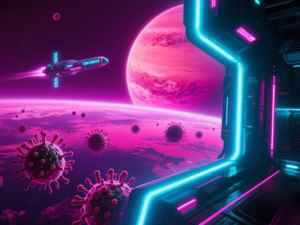
The concept of Panspermia proposes that life can be distributed across the cosmos via asteroids, comets, and other celestial objects. This theory has gained renewed interest following discussions about the potential existence of microbial life in the dense clouds of Venus. A recent study presented at the 2026 Lunar and Planetary Science Conference (LPSC) by researchers from The Johns Hopkins University Applied Physics Laboratory (JHUAPL) and Sandia National Laboratories delves into the possibility of life on Venus being seeded from Earth.
The Venus Life Equation
Utilizing the Venus Life Equation (VLE), a framework developed by Noam Izenberg and colleagues in 2021, the team modeled the potential for life to exist in Venus’ clouds. The VLE functions similarly to the Drake Equation, breaking down the probability of life into several factors. Mathematically, it is expressed as:
L = O x R x C
Here, L represents the likelihood of Extant Life (ranging from 0 to 1), O is the chance that life originated on Venus, R reflects the robustness of a biosphere, and C indicates the continuity of habitable conditions.
Modeling Organic Material Transfer
The research team examined how organic material could survive the journey through space and the harsh conditions of Venus’ atmosphere. They noted that while impacts can generate heat and trauma, studies of meteorites suggest that organic compounds can endure ejection and interplanetary transfer. Upon reaching Venus, these materials must be dispersed within or above the clouds to survive.
To assess this, the team employed the pancake model, a semi-analytic method that describes how a bolide (fireball meteorite) fragments upon entering an atmosphere. This model accounts for the bolide’s ablation, explosion, and subsequent dispersion into a “pancake” of material, referred to as cells.
Findings and Implications
The researchers calculated that hundreds of billions of cells could have been transferred from Earth to Venus’ clouds, with an estimated 100 cells entering the atmosphere each year. Over the past billion years, this could amount to around 20 billion cells potentially arriving from Earth.
While the model has limitations and uncertainties—similar to those found in the Drake Equation—it supports the idea that panspermia between Earth and Venus is feasible. Should future astrobiology missions discover life in Venus’ clouds, it is plausible that such life may have originated from our planet.
This article was produced by NeonPulse.today using human and AI-assisted editorial processes, based on publicly available information. Content may be edited for clarity and style.