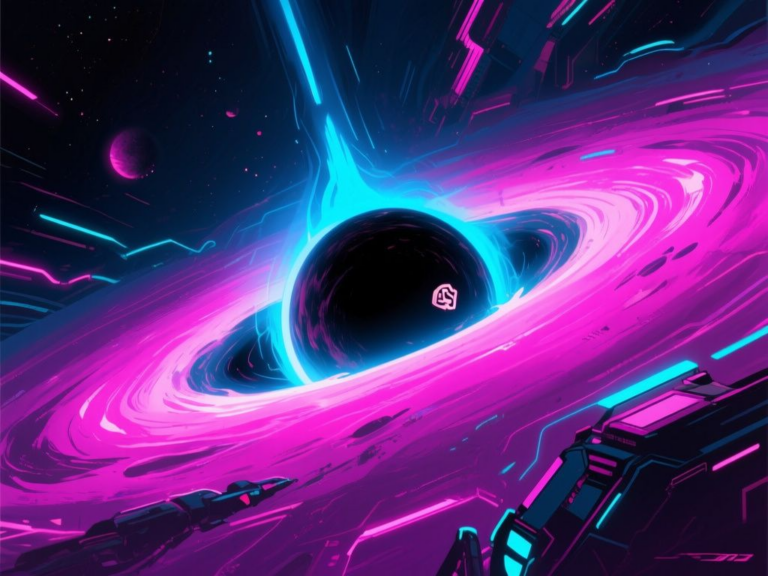
An artist’s impression illustrates the composition of the newly discovered subatomic particle, featuring two charm quarks and one down quark. This week, scientists at CERN announced a significant finding from the LHCb experiment: the detection of the doubly charmed particle known as the Ξcc⁺, or “Xi-cc-plus.” This particle resembles a proton but is approximately four times heavier.
The Ξcc⁺ exists for an incredibly brief moment, flashing in and out of existence in less than a blink of an eye. However, its discovery provides physicists with crucial insights into the structure of matter. This milestone marks the first new particle identified following the upgrades to the LHCb detector completed in 2023, as noted by Vincenzo Vagnoni, the spokesperson for the experiment.
Resolving a Long-Standing Mystery
The identification of the Ξcc⁺ also addresses a 20-year-old mystery. In 2002, researchers at Fermilab reported potential evidence of this particle, but their findings indicated a mass that was significantly lighter than theoretical predictions, lacking the necessary confidence level of 5-sigma for a definitive discovery. In 2017, the LHCb team discovered a related baryon, the Ξcc++, or “Xi-cc-plus-plus,” leading physicists to anticipate that the Ξcc⁺ would have a similar mass. The recent observations confirm these expectations with a confidence level of 7-sigma.
Understanding Quark Combinations
The Large Hadron Collider accelerates protons to nearly the speed of light, with four detectors, including LHCb, collecting data to unravel the complexities of subatomic particles. Hadrons, such as protons, are composed of quarks held together by the strong nuclear force, one of the four fundamental forces in nature. Quarks exist in six “flavors,” and their combinations yield various types of hadrons. For instance, protons consist of two up quarks and one down quark, while the newly discovered Ξcc⁺ contains two charm quarks and one down quark.
Implications for Quantum Chromodynamics
Despite its similarities to the previously identified Ξcc++, the Ξcc⁺ is predicted to have a lifetime up to six times shorter due to intricate quantum effects, making it more challenging to observe. With this discovery, the total number of hadrons identified by LHC experiments reaches 80. While the Higgs boson, discovered in 2012, filled a significant gap in the Standard Model of particle physics, the Ξcc⁺ will nonetheless contribute to advancing the field.
Vagnoni emphasized that this finding will aid theorists in testing models of quantum chromodynamics, the theory governing the strong force that binds quarks into baryons and mesons, as well as more exotic hadrons like tetraquarks and pentaquarks. Looking ahead, the High-Luminosity Large Hadron Collider project aims to enhance the collider’s capacity for particle collisions by a factor of 10 by around 2030, potentially opening new avenues for exploration in particle physics.
This article was produced by NeonPulse.today using human and AI-assisted editorial processes, based on publicly available information. Content may be edited for clarity and style.