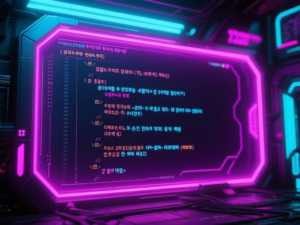
Han (한) is a newly developed general-purpose compiled programming language that utilizes Korean keywords, designed to make programming more accessible for Korean speakers. Developed using Rust, Han compiles to native binaries through LLVM IR and includes a tree-walking interpreter for immediate execution.
Language Features and Design
Han is statically typed and features a range of programming constructs, including:
- Korean keywords for functions, conditionals, and loops, such as 함수 (function), 만약 (if), and 반복 (loop).
- Support for Hangul identifiers, allowing users to name variables and functions in Korean.
- Static typing with five primitive types: 정수 (int), 실수 (float), 문자열 (string), 불 (bool), and 없음 (void).
- Advanced features like closures, pattern matching, and error handling.
These features aim to enhance clarity and beauty in programming, leveraging the unique characteristics of the Hangul writing system.
Cultural Relevance and Global Appeal
Han emerges at a time when interest in Korean culture is surging globally, with millions studying the language. By offering a programming language that incorporates Hangul, Han not only serves as a tool for software development but also as a medium for practicing Korean literacy.
This dual purpose may attract learners and developers alike, bridging the gap between cultural engagement and technical expertise.
Installation and Usage
To install Han, users need to have Rust (version 1.70+) and clang installed. The installation process involves cloning the repository and using Cargo to install the language globally. Users can run programs using commands like hgl interpret for immediate execution or hgl build to compile to a native binary.
Future Development and Community Engagement
While Han is currently functional with various data types and control structures, certain features are still in development, including support for multi-return values and asynchronous programming. The project is open-source, encouraging community contributions and feedback.
As Han continues to evolve, its potential impact on both the programming landscape and Korean language education remains to be seen.
This article was produced by NeonPulse.today using human and AI-assisted editorial processes, based on publicly available information. Content may be edited for clarity and style.
Original source: github.com