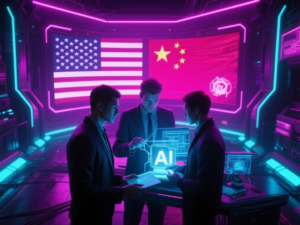
The landscape of artificial intelligence (AI) is often characterized by fierce competition between the US and China. However, recent findings indicate that these two AI powerhouses are engaging in significant collaborative efforts in cutting-edge research.
Collaboration Statistics
A detailed analysis of over 5,000 AI research papers presented at the Neural Information Processing Systems (NeurIPS) conference shows that 141 papers, or approximately 3 percent, feature collaboration between authors from US and Chinese institutions. This trend appears stable, with 134 out of 4,497 papers in 2024 also reflecting joint authorship from both countries.
Shared Innovations
The analysis further highlights how algorithms and models developed in one country are being utilized and adapted in the other. For instance, the transformer architecture, initially developed by a team at Google, appears in 292 papers authored by Chinese researchers. Additionally, Meta’s Llama models are referenced in 106 papers, while Alibaba’s Qwen model is included in 63 papers involving US authors.
Expert Insights
Jeffrey Ding, an assistant professor at George Washington University, emphasizes that the collaboration is not surprising given the intertwined nature of the US and Chinese AI ecosystems. He states, “Whether policymakers on both sides like it or not, the US and Chinese AI ecosystems are inextricably enmeshed—and both benefit from the arrangement.”
Long-lasting Connections
The collaboration extends beyond formal partnerships, as many Chinese researchers study in the US, fostering enduring professional relationships. Katherine Gorman, a spokesperson for NeurIPS, notes that the conference itself exemplifies international cooperation, with collaborations often persisting long after students leave their universities.
As US policymakers and tech leaders express concerns over China’s advancements, this analysis serves as a reminder of the mutual benefits arising from collaboration between the two nations in the AI domain.
This article was produced by NeonPulse.today using human and AI-assisted editorial processes, based on publicly available information. Content may be edited for clarity and style.